
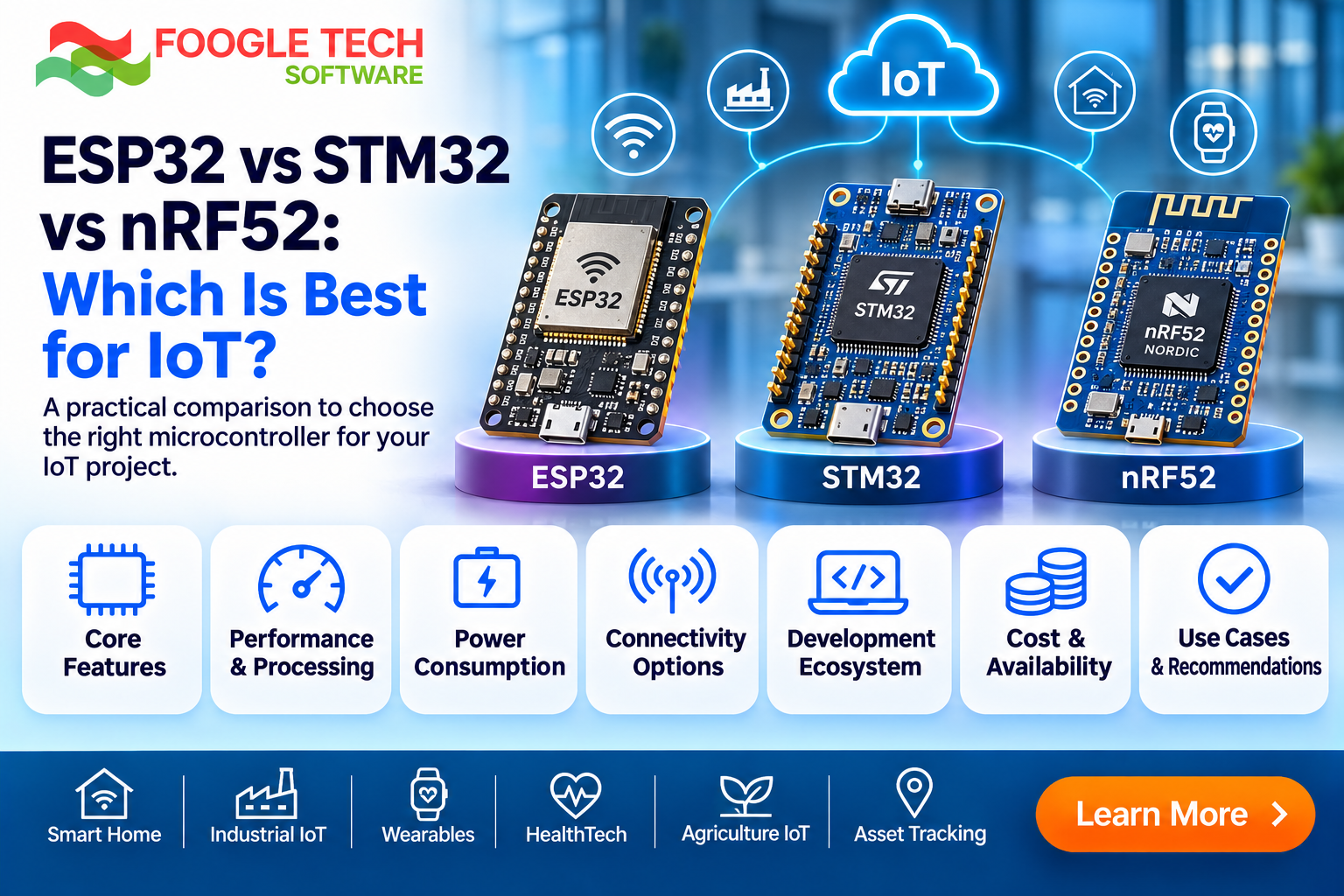
Choosing the right microcontroller is one of the most important decisions when developing an IoT product. It affects hardware design, firmware architecture, connectivity, power consumption, development complexity, and long-term product costs.
With several microcontroller families available, selecting the right platform can be challenging. ESP32, STM32, and Nordic Semiconductor's nRF52 series are three popular options for embedded and IoT development, but each serves different application requirements.
For example, an IoT product requiring built-in Wi-Fi connectivity may benefit from an ESP32 variant, while a battery-powered Bluetooth device may be better suited to an nRF52 SoC. STM32 offers a broad portfolio for applications requiring different processing, peripheral, control, and power capabilities.
The right choice depends on what your product needs to accomplish, how it communicates, and the conditions in which it will operate.
In this guide, we compare ESP32 vs STM32 vs nRF52 across architecture, connectivity, power consumption, processing capabilities, development environments, applications, and cost considerations to help you make an informed hardware decision.
What Are ESP32, STM32, and nRF52?
Before comparing these platforms, it is important to understand their underlying capabilities.
1. ESP32: A Wireless-Focused SoC for Connected Devices
ESP32 is a family of systems-on-chip developed by Espressif Systems. Different ESP32 variants combine processing capabilities with wireless connectivity and integrated peripherals.
Depending on the selected variant, ESP32 devices can support Wi-Fi, Bluetooth Low Energy, Bluetooth Classic, and other wireless technologies.
The platform is particularly useful for applications that require direct wireless communication without adding a separate connectivity processor.
Key characteristics:
- Integrated wireless connectivity on supported variants.
- Processing capabilities for connected applications.
- Multiple peripheral interfaces, including SPI, UART, I2C, and GPIO.
- Support for sensor integration and device communication.
- Software development through ESP-IDF and supported Arduino frameworks.
- Suitable options for smart devices, industrial monitoring, and connected consumer products.
Common applications include smart home devices, wireless controllers, IoT monitoring systems, connected sensors, and automation products.
2. STM32: A Broad Microcontroller Family for Embedded Applications
STM32 is a family of 32-bit microcontrollers developed by STMicroelectronics and based primarily on Arm Cortex-M processor architectures.
Unlike a single-purpose wireless platform, STM32 includes a broad range of microcontroller families designed for different performance, power, security, and peripheral requirements.
Different STM32 variants support different features, including timers, ADCs, communication interfaces, memory configurations, and hardware accelerators.
Some STM32 wireless families also integrate wireless connectivity, while other models require an external communication module.
Key characteristics:
- Broad selection of Arm Cortex-M microcontroller families.
- Options for low-power and high-performance applications.
- Extensive peripheral and timer capabilities.
- Support for SPI, I2C, UART, CAN, USB, and other interfaces depending on the model.
- Development through STM32CubeIDE, STM32CubeMX, and associated software tools.
- Suitable for industrial control, instrumentation, automation, and embedded products.
STM32 is particularly valuable when an application requires specific hardware peripherals, precise control, or a microcontroller selected around detailed system requirements.
3. nRF52: A Low-Power Wireless SoC Family
The nRF52 series from Nordic Semiconductor focuses on low-power wireless applications.
These system-on-chips are commonly used in Bluetooth Low Energy products, wearables, wireless sensors, beacons, and connected accessories.
Selected nRF52 models also support Bluetooth Mesh, Thread, Zigbee, NFC, and other wireless technologies through supported protocols.
Unlike ESP32, the nRF52 family is primarily designed around low-power wireless connectivity rather than integrated Wi-Fi.
Key characteristics:
- Low-power wireless-oriented architecture.
- Bluetooth Low Energy support.
- Multiprotocol options on selected variants.
- Energy-efficient power management capabilities.
- Peripheral interfaces for sensors and external components.
- Development using Nordic's nRF Connect SDK and supported development tools.
Common applications include fitness trackers, wireless sensors, wearable electronics, smart accessories, and battery-powered IoT devices.
ESP32 vs STM32 vs nRF52: Key Differences
The following table highlights the general positioning of these microcontroller families.
| Comparison Factor | ESP32 | STM32 | nRF52 | |---|---|---|---| | Primary focus | Connected wireless devices | General embedded control | Low-power wireless devices | | Processor architecture | Varies by SoC | Primarily Arm Cortex-M | Arm Cortex-M | | Wi-Fi | Available on selected variants | Depends on wireless variant or external module | External connectivity required | | Bluetooth LE | Available on selected variants | Available on selected wireless families | Core strength | | Thread / Zigbee | Available on selected variants | Depends on selected wireless family | Available on supported models | | Power optimization | Supported, variant-dependent | Broad low-power portfolio | Strong low-power focus | | Peripheral support | GPIO, UART, SPI, I2C and others | Extensive model-dependent peripherals | UART, SPI, I2C and others | | Typical applications | Smart devices and Wi-Fi IoT | Industrial and embedded control | Wearables and wireless sensors |
Important: These are family-level comparisons, not specifications for every individual chip. Exact processing performance, memory, peripheral availability, and power consumption must be checked against the selected part number and its datasheet.
1. Processing Performance and Architecture
Processing capability is an important consideration when selecting a microcontroller.
Your device may need to process sensor readings, control motors, manage communication protocols, execute application logic, or perform signal processing.
ESP32 Processing Capabilities
ESP32 variants offer different processor architectures and performance levels.
They are suitable for connected applications requiring device-side processing alongside wireless communication.
For example, a smart monitoring device may use an ESP32 to collect sensor readings, process measurements, manage Wi-Fi communication, and transmit information to a cloud platform.
Some variants also offer additional capabilities for more demanding applications.
However, the actual processing resources depend on the selected ESP32 model.
STM32 Processing Capabilities
STM32 covers a wide performance range, from smaller microcontrollers for simple control tasks to more capable devices for complex embedded applications.
Different families offer different processor cores, memory configurations, hardware peripherals, and acceleration capabilities.
This flexibility makes STM32 suitable for products that require precise hardware control, time-sensitive operations, and specific processing resources.
nRF52 Processing Capabilities
nRF52 devices use Arm Cortex-M processors designed for efficient embedded and wireless workloads.
Their processing resources are suitable for applications such as Bluetooth communication, sensor management, wireless data transmission, and low-power device control.
For applications requiring substantial local computation, the selected model's processing and memory limits need careful evaluation.
Which Platform Should You Choose?
Choose ESP32 when your application combines wireless connectivity with moderate device-side processing. Consider STM32 when the product requires particular processing, control, or peripheral capabilities. Select nRF52 when efficient wireless communication and battery-powered operation are central requirements.
2. Connectivity: Wi-Fi, Bluetooth, and Wireless Protocols
Connectivity requirements can significantly influence your hardware selection.
ESP32 Connectivity
ESP32 is particularly useful for products that need direct Wi-Fi connectivity.
Depending on the variant, it can support:
- Wi-Fi.
- Bluetooth Low Energy.
- Bluetooth Classic on supported models.
- IEEE 802.15.4 on selected newer variants.
This makes the ESP32 family suitable for devices that communicate directly with routers, mobile applications, or connected platforms.
STM32 Connectivity
STM32 connectivity depends on the selected microcontroller.
Many STM32 models provide wired communication interfaces such as UART, SPI, I2C, USB, and CAN.
Wireless connectivity can be implemented through external modules or selected STM32 wireless product families.
This allows developers to build products around specific communication requirements rather than relying on one standard wireless configuration.
nRF52 Connectivity
nRF52 is particularly strong in Bluetooth Low Energy applications.
Selected devices support additional protocols such as:
- Bluetooth Mesh.
- Thread.
- Zigbee.
- NFC.
These capabilities make nRF52 suitable for wireless sensor networks, connected accessories, and smart home products.
Which Platform Is Better for Connectivity?
For integrated Wi-Fi applications, consider suitable ESP32 variants. For Bluetooth-focused and low-power wireless devices, evaluate nRF52. For products requiring flexible wired interfaces or a separately selected communication architecture, STM32 offers several options.
3. Power Consumption and Battery Life
Power consumption becomes especially important for products that operate on batteries.
A small difference in average current consumption can have a significant effect on battery replacement frequency and overall product usability.
ESP32 Power Consumption
ESP32 variants provide different power-management features and operating modes.
They can be configured for lower-power applications through sleep modes, peripheral management, and wireless communication optimization.
However, Wi-Fi communication and frequent wireless activity can increase overall energy consumption.
For battery-powered products, engineers should carefully evaluate the device's active time, communication frequency, sleep current, and wireless transmission requirements.
STM32 Power Consumption
STM32 includes dedicated low-power microcontroller families.
Depending on the selected device, developers can use different low-power operating modes and power-management features.
STM32 can be suitable for battery-operated devices, sensor systems, and products that spend significant time in sleep or standby modes.
nRF52 Power Consumption
Low-power wireless operation is one of the main strengths of the nRF52 family.
Its power-management capabilities make it attractive for devices that transmit small amounts of data periodically and remain in low-power states between communication events.
Examples include wearable devices, Bluetooth sensors, and wireless monitoring products.
Which Platform Is Best for Battery-Powered IoT Devices?
nRF52 is worth evaluating first for Bluetooth-centric battery-powered products. Low-power STM32 variants may also be suitable for applications involving periodic sensing and control.
ESP32 remains an option when the application needs its connectivity features and the battery budget supports the expected workload.
The final decision should be based on measured power consumption under realistic operating conditions, not processor specifications alone.
4. Development Tools and Software Ecosystem
The development environment affects engineering productivity, debugging, firmware maintenance, and time to market.
ESP32 Development Environment
Espressif provides ESP-IDF, its official development framework for ESP32 products.
Developers can use it to build firmware, configure peripherals, manage networking, integrate wireless protocols, and implement application functionality.
Arduino-based development is also available for supported ESP32 devices and can be useful for prototyping.
STM32 Development Environment
STM32 development commonly uses STM32CubeIDE and STM32CubeMX.
These tools support peripheral configuration, project initialization, code generation, firmware development, and debugging.
The STM32 ecosystem also includes libraries, development boards, and software packages for different applications.
nRF52 Development Environment
Nordic Semiconductor provides the nRF Connect SDK for supported wireless development.
It supports firmware development and integration of Bluetooth LE and other wireless capabilities.
The ecosystem also includes debugging tools, development kits, and software resources for building connected devices.
Development Recommendation
The best development environment depends on your engineering team's experience, required protocols, debugging needs, and long-term maintenance strategy.
5. Development Cost and Product Considerations
Microcontroller selection should not be based solely on the purchase price of the chip.
The total cost of an embedded product includes several components:
- Microcontroller or SoC cost.
- External communication modules.
- Memory and supporting components.
- PCB design and manufacturing.
- Firmware development.
- Testing and debugging.
- Regulatory and wireless certification.
- Production and long-term maintenance.
For example, a Wi-Fi-based device may benefit from an ESP32 variant with integrated wireless connectivity, potentially reducing the need for a separate Wi-Fi controller.
A product using STM32 may require an external wireless module, depending on its architecture. However, this can also provide flexibility when selecting communication hardware.
An nRF52-based product may be a practical choice for Bluetooth-centric designs where battery life and wireless performance are major priorities.
The best financial decision comes from evaluating the complete bill of materials, development effort, production requirements, and expected product lifecycle.
Which Microcontroller Is Best for Different IoT Applications?
There is no universally best microcontroller. The correct choice depends on the application's connectivity, processing, power, and peripheral requirements.
| IoT Application | Platform to Evaluate | Main Consideration | |---|---|---| | Wi-Fi smart home devices | ESP32 | Integrated wireless connectivity | | Bluetooth wearables | nRF52 | Low-power wireless operation | | Industrial controllers | STM32 | Control and peripheral requirements | | Wireless sensor nodes | nRF52 / STM32 | Battery life and communication needs | | Wi-Fi monitoring devices | ESP32 | Direct cloud connectivity | | Motor control systems | STM32 | Timers and control peripherals | | BLE-enabled accessories | nRF52 | Bluetooth-focused architecture | | Connected industrial products | ESP32 / STM32 | Connectivity and hardware integration |
The recommendations are starting points, not fixed rules. Product requirements and exact component specifications should determine the final selection.
How to Choose the Right Microcontroller for Your IoT Product
Before finalizing a microcontroller, evaluate the following engineering requirements.
1. Define Connectivity Requirements
Determine whether the product requires Wi-Fi, Bluetooth LE, Bluetooth Mesh, Thread, Zigbee, Ethernet, cellular connectivity, or a combination of technologies.
Avoid selecting hardware before understanding how the device will communicate.
2. Evaluate Processing Requirements
Identify the operations the device must perform.
Consider sensor processing, control algorithms, communication stacks, memory requirements, and any local AI or signal-processing workloads.
3. Calculate the Power Budget
For battery-powered devices, estimate the energy required during active operation, wireless transmission, sleep states, and peripheral usage.
Validate these estimates through hardware testing.
4. Check Peripheral Compatibility
Make sure the selected microcontroller supports the interfaces required by your hardware.
These may include:
- UART.
- SPI.
- I2C.
- ADC.
- PWM.
- CAN.
- USB.
- GPIO.
5. Review Security Requirements
Evaluate secure boot, hardware cryptographic support, secure firmware updates, device identity, and available security libraries.
Security requirements should be addressed during architecture design rather than added after firmware development.
6. Consider Component Availability and Lifecycle
Review component sourcing, manufacturer documentation, product longevity, development tools, and supply-chain risks.
The selected platform should support the expected production volume and maintenance period.
7. Validate the Hardware Through Prototyping
Build a proof of concept to test the important technical assumptions.
Measure wireless range, current consumption, processing performance, thermal behavior, peripheral compatibility, and communication reliability before finalizing the PCB.
Common Mistakes to Avoid During Microcontroller Selection
Choosing the wrong microcontroller can increase engineering costs and create problems during product development.
Here are some mistakes worth avoiding.
- Selecting hardware based only on price: The cheapest chip may require additional components or extensive firmware customization, increasing total development costs.
- Ignoring power consumption: Battery-powered products require power profiling under real-world usage conditions.
- Overlooking connectivity requirements: Selecting a device without the required wireless or communication interfaces may force an additional hardware redesign.
- Underestimating memory requirements: Firmware frameworks, communication stacks, buffers, and application logic all consume memory.
- Ignoring component availability: A design that depends on difficult-to-source components can create production delays.
- Skipping hardware validation: Prototype testing helps identify power, RF, thermal, and compatibility issues before mass production.
Why Choose FoogleTech for Embedded and IoT Product Development?
Selecting a microcontroller is only one part of building a reliable connected product. Successful development also requires PCB engineering, firmware programming, hardware integration, communication testing, and long-term software support.
At FoogleTech Software, we help businesses build embedded systems and connected products through integrated hardware and software engineering.
Our engineering capabilities include:
- Embedded Systems Development: We develop firmware using Embedded C, C++, RTOS, and embedded Linux for different hardware platforms.
- IoT Development: We build connected-device software involving sensor integration, wireless communication, cloud connectivity, and monitoring applications.
- Firmware Development: We support device drivers, peripheral integration, communication protocols, debugging, and firmware optimization.
- PCB Design and Hardware Engineering: We support circuit design, PCB layout, component selection, hardware integration, and prototype development.
- IoT Product Development: We help bring connected products together through hardware, firmware, communication, backend development, and application integration.
Our approach starts with understanding the product's technical requirements before recommending a suitable hardware and software architecture.
Whether you are developing a wireless sensor, industrial controller, smart home product, or connected commercial device, we can help plan and implement the required embedded engineering components.
Explore our embedded systems development services and IoT development services to learn more.
Planning a New Embedded or IoT Product?
Let's evaluate your microcontroller requirements, connectivity architecture, firmware needs, and hardware design.
Contact FoogleTech Software to discuss your embedded product development project.
Frequently Asked Questions
1. Which Is Better, ESP32 or STM32?
Neither is universally better. ESP32 is particularly useful for connected applications requiring integrated Wi-Fi or Bluetooth on supported variants. STM32 offers a broader range of microcontrollers for industrial control, embedded processing, and peripheral-intensive applications.
2. Is ESP32 Suitable for Industrial IoT Applications?
Yes. ESP32 variants can be used in industrial IoT applications involving monitoring, wireless communication, automation interfaces, and connected sensors. However, industrial suitability depends on the specific chip, module, operating environment, electrical design, security requirements, and applicable certifications.
3. Is STM32 Suitable for Battery-Powered IoT Devices?
Yes. STM32 includes low-power microcontroller families with different sleep modes and energy-management capabilities. The appropriate model depends on application processing requirements and expected battery life.
4. Why Is nRF52 Popular for Bluetooth Low Energy Devices?
The nRF52 family is designed around low-power wireless applications and offers Bluetooth Low Energy support. Selected models also support Bluetooth Mesh, Thread, Zigbee, and other wireless technologies.
5. Can ESP32 Replace STM32?
In some applications, yes. However, ESP32 and STM32 are different microcontroller families with different hardware capabilities. An ESP32 may replace an STM32 in a connected product if its processing, peripherals, power, timing, and reliability requirements are suitable.
6. Can STM32 Work With Bluetooth and Wi-Fi?
Yes. STM32-based products can support Bluetooth and Wi-Fi through external communication modules or selected wireless STM32 families. The integration method depends on the selected hardware architecture.
7. Which Microcontroller Is Best for Wearable Devices?
The nRF52 family is worth considering for many Bluetooth-based wearable products because of its low-power wireless capabilities. The final selection depends on sensor requirements, application complexity, battery capacity, wireless range, and memory needs.
8. Can Two Microcontrollers Be Used in One IoT Product?
Yes. Some products use separate microcontrollers for different responsibilities, such as a primary controller for application logic and a dedicated wireless controller for connectivity. This approach can provide architectural flexibility but adds hardware, communication, firmware, and testing complexity.
9. What Factors Affect Microcontroller Selection for IoT Product Development?
Important factors include processing performance, power consumption, connectivity, memory, peripheral interfaces, security, component availability, development tools, regulatory requirements, and total product cost.
Conclusion
ESP32, STM32, and nRF52 are useful microcontroller families for different types of embedded and IoT products.
ESP32 is a strong option for many wireless connected devices, particularly applications requiring Wi-Fi. STM32 provides flexibility across industrial control, low-power embedded systems, and performance-focused applications. nRF52 is particularly suitable for Bluetooth-centric products where efficient wireless communication and battery life are important.
The right decision should come from evaluating the complete product architecture rather than comparing individual chip features in isolation.
A well-planned microcontroller selection process helps reduce redesign risks, improve development efficiency, and create products that are easier to manufacture and maintain.
At FoogleTech Software, we help businesses turn embedded and IoT concepts into reliable products through firmware engineering, PCB design, hardware integration, and connected software development.
Looking for an experienced embedded and IoT development partner? Talk to FoogleTech about your next product engineering project.